Complexity and Management Conference 5th-7th June 2026

What does it mean to say the world is complex? Implications for practice.

If the bios on LinkedIn are anything to go by, it would seem as though most people working in organisational context now accept that the world is complex. However, taking that initial step is easy. What we might do about that insight depends how we understand complexity.

Management is an instrumental discipline and still has tendencies to assume that complexity can be managed. For example, there might be an assumption that we can create the kind of complexity we want, or that organisations are complex sometimes and other times they’re not; we get to choose.  There’s planning, and then there is emergence understood as the absence of planning, as though planning and trying to implement the plan aren’t also emergent activities. These are fantasies of prediction and control which fall back on if-then causality, the efficient causality that the complexity sciences call into question.

But accepting that the world is complex with radical implications for practice is not the same as saying we can do nothing. The pragmatic question is: what is it that we already find ourselves doing, and what sense do we make of that?

For next year’s conference we are delighted that Dr Jean Boulton has accepted our invitation to be keynote speaker and give us food for thought. You can read her bio, but in brief Jean has a PhD in theoretical physics, and is a visiting academic at the University of Bath and Cranfield. Her publications include Embracing Complexity, written with Peter Allen and Cliff Bowman (2016), and The Dao of Complexity,  which was published last year.

Jean will speak to the following:

It’s complex whether you like it or not

The word complexity might suggest an impossible, chaotic, ambiguous, useless muddle: a bad thing we should aim to simplify, organise and master.

But what if complexity is the natural way of things, and in its depths lie the source of novelty, creativity and adaptability? 

The science of complexity conveys a view of the world as dynamic, richly interdependent and full of variety. It is a world – organic and emergent, shaped by history and context – that is naturally patterned yet always in process.

In this session, Jean Boulton will explore this view of complexity emerging from physics and biology, consider how this resonates with the work of others including Ralph Stacey and Paul Cilliers.

She will then explore what this means for practice. How does ‘embracing complexity’ impact leadership, strategy development, change and the shaping of organisational forms?  

The conference is held in the beautiful setting of the Roffey Park Institute near Horsham, UK. The food is good, the company uplifting and the currency of the conference is conversation.

I will post the booking page on the University website in January, but in the meantime, hold that date.

Transformative possibilities in the everyday: habit, affect, and the unconscious. A talk by Prof Carolyn Pedwell.

Prof Carolyn Pedwell gave an overview of her book Revolutionary Routines at the Complexity and Management Conference, 2025. You can watch her presentation here: https://www.youtube.com/watch?v=niWTBSKABmM&t=12s

In her talk she covered a number of topics which privileged the every day, local and emergent interactions between humans, which is also the subject/object of our research community.

In response I re-presented some of the themes she covered from a complexity perspective, not as a form of critique, but as a way of bringing to light what it was I saw in her book when I first read it. I thought she would be a great speaker for our conference. Carolyn’s book and the perspective of perspectives we term complex responsive processes have family resemblances.

Continue reading

Complexity and Management Conference 6-8th June 2025 now booking

Transformative possibilities in the everyday – habit, affect and the unconscious.

We are shaped by society, but at the same time we shape society in our continuous interactions with each other. Better understanding our relationships and habits, which have a quality of regular-irregularity, tells us something about each other, but also about how society works. Unpicking our socialisation, past and present, gives us some insight into broader social patterns. And this also points to the importance of working in a group – an individual can only work out so much on their own through reflection, given our own biases and habits of thought.

The Complexity and Management Conference 2025 gives participants an opportunity to dwell in a group and pay attention to patterns of relating which never repeat in exactly the same way, and thus offer the potential for novelty to arise.

We are delighted to have Carolyn Pedwell, Professor of Digital Media in the Sociology Department at Lancaster University, as a keynote speaker to explore these themes with us. Amongst Carolyn’s publications is her book Revolutionary Routines: The Habits of Social Transformation (McGill-Queens UP, 2021), which explores the paradoxical quality of habits, which enact the possibility of continuity and change both at the same time.

The conference begins on Friday 6th June 2025 and finishes at lunchtime on Sunday 8th. The currency of the conference is conversation and exploration in large groups and small.

You can find the booking page here.

On Friday 6th there is a one-day introduction to the perspective of perspectives we refer to as complex responsive processes of relating.

The conference is residential and the conference fee covers all board and lodging. Full refund up to one week before the conference.

Complexity and organisations – researching practice

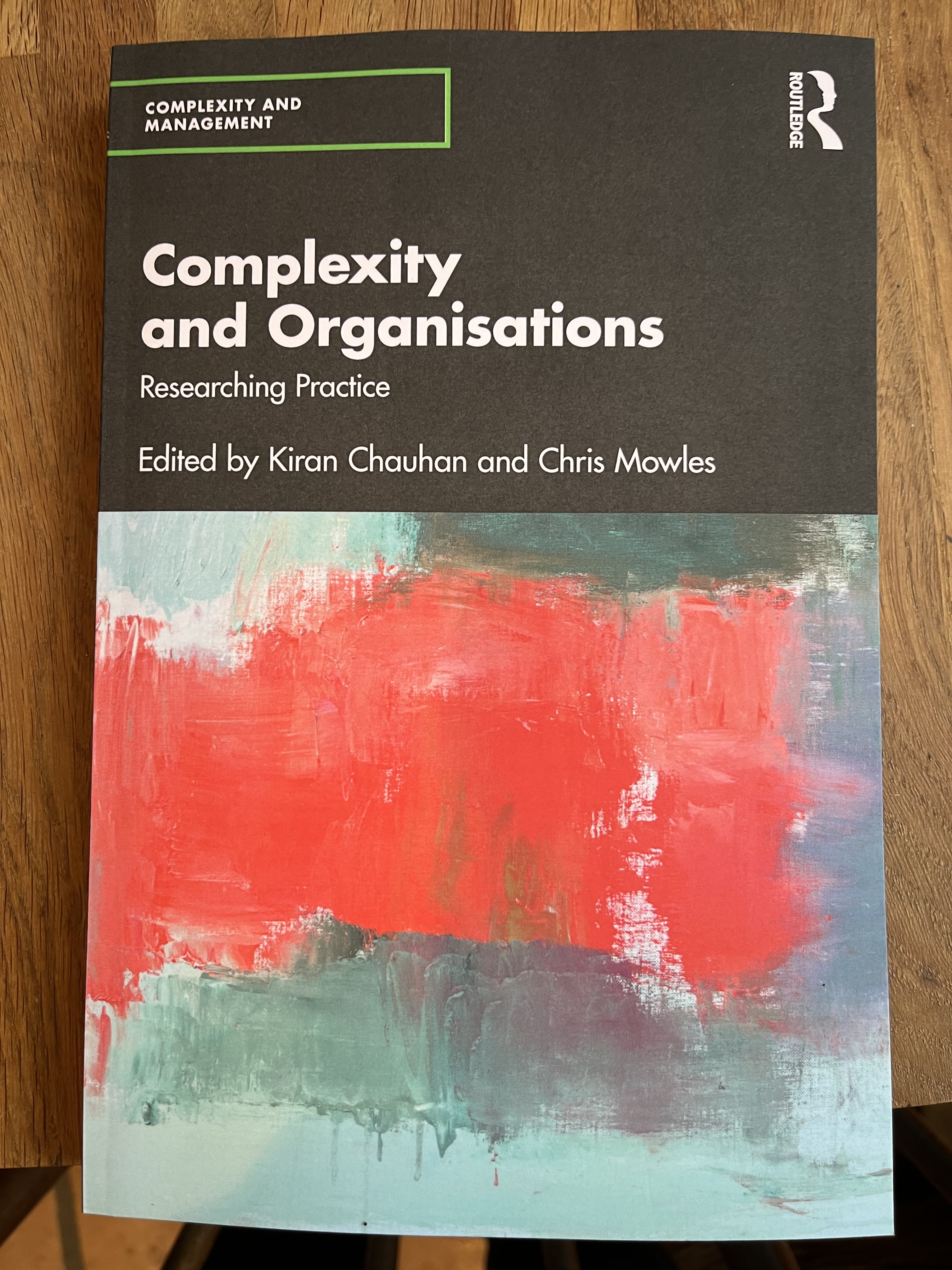
Complexity and Organisations: researching practice, the fourth volume in the Complexity and Management new series is published at the end of this month. Produced by the complexity research community at Hertfordshire Business School, the book explores how we can take complexity seriously as we inquire into our working worlds.

Drawing on their experiences as leaders, managers, researchers and educators, the contributing authors offer insights about exploring social life without trying to reduce or simplify it’s messiness and unpredictability. Addressing themes of history, culture and belonging, compromise, doubt, confidence and its lack, grief and loss, actors and non-human actors, ethics, values and politics, they provide accounts of taking experience seriously, of mobilising our capacity for reflexivity, with all its limitations, in pursuit of understanding more of what it is to be humans amongst humans trying to get stuff done together. 

In doing so they make a number of assumptions about organisations and social life more generally.

At the core of organisational life are fluctuating relationships: I am because we are. There are limits to how much we can make the world in our own image, choose, predict and control as if we were autonomous, rational individuals.

We make organisations but organisations make us, a position which deflates the omnipotent assumption that managers and leaders can ‘create cultures’ of their choosing bend the future to their will. We are more influenced than influencing and paying attention to the push-pull of power relationships may give us greater insight into the qualities and limitations of our agency. We are all caught up in the game of organisational life, so how does the game affect us and our sense of belonging and identity; how are we affecting others?

If we are to illuminate how things became the way they are, it matters that we try and understand practical dilemmas in their history and context, and notice specific human bodies acting and speaking in particular ways. We are all shaped by broader social trends which play out differently in different organisations at different times. Management methods taught in business schools may be helpful in general, but we work with known others in the particular here and now. What can we say about the paradox of negotiating with particular others about general dilemmas that help us better understand the tasks we have before us?

Humans are both complex and flawed. Contemporary organisations acknowledge feeling to the extent that it can be harnessed for organisational ends. We are allowed to be passionate, positive and collaborative, but being political, rivalrous and critical are harder to take account of and speak about. Perhaps we can only be wiser about organisations if we can be wiser about ourselves, and our flawed human nature is the crack through which the light gets in. Our anxiety in the face of uncertainty, our need to belong and be recognised our competitive-cooperative impulses, all contribute to the flux and change of organisational life.

Suitable for the curious and the perplexed, whether you are consultants, pracademics, managers or leaders, this volume is a field guide for making better sense of everyday complexity.

Chapters by Drs Kiran Chauhan, Sune Bjørn Larsen, Sophie Wong, Karina Solsø Iversen, Mikkel Brahm, Helle Stoltz, Jannie Rasmussen, Tobit Emmens and Maj Karin Askeland.

Complexity & Management Conference 6-8th June 2025

Transformative possibilities in the everyday – habit, affect and the unconscious

I was recently in a training being inducted into a new leadership programme. The course facilitators placed a heavy emphasis on bringing about changed ‘behaviours’ in those who were to study on the programme. Implicit in this focus is the idea that we know in advance what leaderly activity looks like. Additionally, the use of the plural ‘behaviours’, carries a false precision. The idea, I suppose, is that these ‘behaviours’ are identifiable and measurable, contributing to ‘evidence’ that someone has learned the leadership skills that are required, and can bring about the expected  ‘transformation’.

This programme is not at all unusual in having designs on our habitual conduct. Our family groups, the organisations we work for, the societies we live in all shape our every day behaviour, our habitual ways of dealing with each other, and may have aspirations for shaping them further: to make us conform, to make us cohere with others, to behave respectfully, to help groups work, to encourage us to spend more and commit more. While our socialisation may take  place largely prereflectively and unconsciously, in advanced capitalist economies there are algorithms, marketing and advertising disciplines which deliberately seek to direct our everyday actions towards certain ends. We live in an economy of persuasion. To what extent do we notice and become mindful of the ways in which our habits are shaped and how try to shape others?

From a pragmatic perspective, concentrating on the actions of one individual, whether they are in a leadership position or not, leaves out a great deal. For example, the leader may propose, but how does everyone else respond? Until we take the gesture and the response together we cannot begin to understand what an action means. And what kind of feelings are evoked in the exchange? To what degree are the habitual patterns of relating affected by the leader’s ‘behaviours’ as opposed to the broader game of games which is taking place in the organisation and beyond? How does the unconscious manifest in group dynamics, particularly if the group is anxious and uncertain? To what degree do context, time and artefacts make a difference?

While organisations tend to have grand schemes of wholesale transformation, change is a complex and uncertain undertaking.  From a complexity perspective, whatever we take transformation to be it is just as likely to arise from the micro, the minor gesture, the adjustments of habit in the every day following a break down, which can escalate into population-wide change.

At next year’s conference we are delighted to have Carolyn Pedwell, Professor of Digital Media in the Sociology Department at Lancaster University,  as key note speaker to explore these themes with us. Amongst Carolyn’s publications is her book Revolutionary Routines: The Habits of Social Transformation (McGill-Queens UP, 2021), which explores the paradoxical quality of habits, which enact the possibility of continuity and change both at the same time.

The conference begins on Friday 6th June 2025 and finishes at lunchtime on Sunday 8th. The currency of the conference is conversation and exploration in large groups and small.

I will put up a payment site in the New Year. Look forward to seeing you there.

CMC 2024 – book now for early bird discount.

Only three weeks to go before the end of the early bird discount for this year’s Complexity and Management conference. You can book here.

The theme for this year’s conference is Complexity and Culture.

We are delighted to welcome Dr Patricia Shaw, who will be familiar to many of you. She will give the key note in conversation with Prof Nick Sarra.

The Complexity and Management Conference is an antidote to the sense of drift and thoughtlessness which can afflict managers in organisations because of the sheer complexity and pace of work, and the abstractions of contemporary management discourse. The currency of the conference is conversation, reflection and meaning-making about things that matter to us in and beyond the workplace.

Saturday afternoon will be given over to delegate-led workshops to explore the conference theme.

Sunday morning will be a chance for Prof Karen Norman and I to reflect together on some of the themes of the conference to offer a further reflexive turn in thinking.

Hope to see you there.

Complexity and Culture, the 2024 Complexity and Management Conference 7th-9th June – update.

The annual Complexity and Management conference is open for booking here.

The concept of culture in organisations is widely used but often poorly understood. So how do group identities and a sense of belonging emerge, and what methods might we employ to understand them better? How might we do justice to the contradictions and tensions that are constant themes shaping the experience of group life?

Our keynote speaker Professor Candida Yates has had to withdraw her offer speak with great regret. Instead we are delighted to welcome Dr Patricia Shaw, who will be familiar to many of you, who will give the key note instead, in conversation with Prof Nick Sarra.

The Complexity and Management Conference is intended as an antidote to the sense of drift and thoughtlessness which can afflict managers in organisations because of the sheer complexity and pace of work, and the abstractions of contemporary management discourse. The currency of the conference is conversation, reflection and meaning-making about things that matter to us in and beyond the workplace. Saturday afternoon will be given over to delegate-led workshops to explore the conference theme. Sunday morning will be a chance for Prof Karen Norman and I to reflect together on some of the themes of the conference to offer a further reflexive turn in thinking.

For those seeking an insight into some of the ideas informing the body of thought termed complex responsive processes of relating, there is a one day workshop on Friday 7th June.

The conference begins at 7pm on Friday 7th (unless you attend the one day workshop, which begins at 9.30am) and finishes at 2pm on the 9th June. The fee includes all board and lodging at Roffey Park Institute, Horsham, UK.

Any questions, write to me at c.mowles@herts.ac.uk

Booking now: Complexity and Culture, the 2024 Complexity and Management Conference 7th-9th June.

Click here to book your place on the Comlexity and Management Conference 7-9th June at Roffey Park, UK.

The concept of culture in organisations is widely used but often poorly understood. So how do group identities and a sense of belonging emerge, and what methods might we employ to understand them better? How might we do justice to the contradictions and tensions that are constant themes shaping the experience of group life?

Working with the intersection of symbolism, politics and culture, Professor Candida Yates will talk about a current research project where she is trying to understand how the community imaginary is developed and sustained. Drawing on work she is undertaking with a community on the south coast of the UK, Professor Yates will give examples of art-based and psycho-social approaches to exploring to the emergence of meaning in a UK maritime community through the exploration of thoughts, feelings, politics and experience.

Candida Yates is Professor of Culture and Communication, Bournemouth University.

The annual Complexity and Management Conference is intended as an antidote to the sense of drift and thoughtlessness which can afflict managers in organisations because of the sheer complexity and pace of work, and the abstractions of contemporary management discourse. The currency of the conference is conversation, reflection and meaning-making about things that matter to us in and beyond the workplace. Saturday afternoon will be given over to delegate-led workshops to explore the conference theme.


The conference begins at 7pm on Friday 7th (unless you attend the one day workshop, which begins at 9.30am) and finishes at 2pm on the 9th June. The fee includes all board and lodging at Roffey Park Institute, Horsham, UK.

Look forward to seeing you there. Let me know if you would like to run a workshop on Saturday afternoon.

Complexity and the emergence of culture – Complexity and Management Conference, June 7-9th 2024.

View Post

Complexity and Management Centre

The annual Complexity and Management Conference, held this year between 7th-9th June 2024 at Roffey Park in Horsham, UK, is intended as an opportunity to make sense of the rationally irrational processes that we get caught up in at work. The currency of the conference is conversation, reflection and meaning-making about things that matter to us in the workplace and beyond.

The topic for this year is culture which is often considered to be thing-like, and capable of manipulation by leaders and managers to create the outcomes we think we want. These are often ideals of high performance, collaboration and positivity.

However, whatever we think of as culture, the habituated pattern of behaviour which allows us to recognise each other as we co-operate and compete, is not so easily subjected to our plans and intentions. We are as much shaped by the habitus as we can shape it.

This year we are delighted to invite Professor Candida Yates to help us explore this theme . She will talk about a current research project where she is trying to understand how the community imaginary is developed and sustained. Drawing on work she is undertaking with a community on the south coast of the UK, Professor Yates will give examples of art-based and psycho-social approaches to exploring to the emergence of meaning in a UK maritime community through the exploration of thoughts, feelings, politics and experience.

Candida Yates is Professor of Culture and Communication, Bournemouth University. She is an interdisciplinary scholar and applies a psychosocial approach to culture, politics and society and has published widely in that field. She works with academics, clinicians, creatives and cultural organisations to create new understandings of emotion and affect in the public sphere. She is a Co-Director of the BU Centre for the Study of Conflict, Emotion and Social Justice and sits on the Executive Boards of the Association for Psychosocial Studies; is a Founding Scholar of the British Psychoanalytic Council and is an Academic Research Associate of the Freud Museum. She is Joint-Editor of the Routledge book series: Psychoanalysis and Popular Culture, andis a Contributing Editor on the journals Psychoanalysis, Culture and Society, and The Journal of Psychosocial Studies.

The conference starts with an inaugural supper on the evening of Friday June 7th and will finish after lunchtime on the 9th June. The conference fee includes all board and lodging at Roffey Park Insitute, which is a residential setting.

There will also be an introductory day on complexity and organisation and the unique perspective of complex responsive processes on Friday 7th.

The booking page will go up on the University of Hertfordshire website at the end of this month.

For any queries contact me on c.mowles@herts.ac.uk

Complexity and Management Conference 7th-9th June 2024

Complexity and the emergence of culture

The concept of culture in organisations is widely used but often poorly understood. So how do group identities and a sense of belonging emerge, and what methods might we employ to understand them better? How might we do justice to the contradictions and tensions that are constant themes shaping the experience of group life? 

Working with the intersection of symbolism, politics and culture, Professor Candida Yates will talk about a current research project where she is trying to understand how the community imaginary is developed and sustained. Drawing on work she is undertaking with a community on the south coast of the UK, Professor Yates will give examples of art-based and psycho-social approaches to exploring to the emergence of meaning in a UK maritime community through the exploration of thoughts, feelings, politics and experience.

Candida Yates is Professor of Culture and Communication, Bournemouth University. She is an interdisciplinary scholar and applies a psychosocial approach to culture, politics and society and has published widely in that field. She works with academics, clinicians, creatives and cultural organisations to create new understandings of emotion and affect in the public sphere. She is a Co-Director of the BU Centre for the Study of Conflict, Emotion and Social Justice and sits on the Executive Boards of the Association for Psychosocial Studies; is a Founding Scholar of the British Psychoanalytic Council and is an Academic Research Associate of the Freud Museum. She is Joint-Editor of the Routledge book series: Psychoanalysis and Popular Culture, and is a Contributing Editor on the journals Psychoanalysis, Culture and Society, and The Journal of Psychosocial Studies.

The annual Complexity and Management Conference is intended as an antidote to the sense of drift and thoughtlessness which can afflict managers in organisations because of the sheer complexity and pace of work, and the abstractions of contemporary management discourse. The currency of the conference is conversation, reflection and meaning-making about things that matter to us in and beyond the workplace.

Beginning with an inaugural dinner in the evening of Friday 7th of June, the formal conference will start on Saturday morning with Prof Yates’ thought-provoking key note to encourage the movement of thinking. Thereafter it is reflection and reflexivity continuously till lunchtime Sunday on topics brought by the conference participants themselves.

The conference promises good food, stimulating conversation, and a chance to rediscover oneself in one’s work.

Booking for the conference will begin in the New Year 2024. Next year’s conference will be held in association with the KIOL Executive Leadership programme in Denmark.

Hope to see you there.